How-To Guides · For homeowners & landscapers
How to Measure a Pile of Gravel, Dirt, Sand or Mulch in Cubic Yards (and Tons)
A pile just landed in your driveway and you want to know how many yards it is, and how many tons. Here is how to measure it with a tape and a formula, what goes wrong, and the faster way with the phone in your pocket.
In short
- Measure the pile’s base diameter and its height, then use the cone formula: 0.2618 × diameter² × height gives cubic feet. Divide by 27 for cubic yards.
- A pile 14 ft across and 4 ft high is about 205 ft³, or 7.6 yd³, which is roughly 10–11 US tons of crushed stone.
- Cones underestimate loader-built piles with flat tops by 20–40%. Measure the top too, or scan the pile, when the number matters.
- A phone scan takes a few minutes: walk once around the pile and read the volume, its ± range and a weight estimate.
What you need
A tape measure (a 100-foot open reel is ideal), a straight pole or 2×4 that is longer than the pile is tall, a helper, and a level app on your phone or a string line. Pick a moment when nobody is loading from the pile, because a bucket taken from the far side changes the answer while you write it down.
Step 1: Measure the base
Walk once around the pile and look for the toe, the line where loose material meets the ground. That line is the footprint, and everything inside it counts. Measure straight across the base in two directions at right angles and average them; most piles are a little oval, and the average diameter is what the formula wants. If the pile is clearly long rather than round, keep both numbers for the ridge formula in step 3.
Do not include the thin skirt of scattered stones beyond the toe. A thumb’s depth of gravel spread over a wide ring looks like a lot of pile and holds almost nothing. If the pile sits against a wall or a bin side, measure what you can reach and note which side is straight; you will use half the formula later.
Step 2: Measure the height
Height is the vertical distance from the ground to the crest, not the length of the slope. Stand the pole vertical beside the pile, check it with the level app, and have your helper sight across the crest to the pole and mark where their eye line hits. Measure the mark.
If you only have a tape, measure the slope from the toe to the crest and the slope angle with the phone’s level. Height equals slope length times the sine of the angle. A 7-foot slope at 35°, which is where dry crushed stone usually settles according to the Engineering ToolBox table of angles of repose, is a 4-foot-high pile. Do not climb the pile; it changes the shape, and loose stone is treacherous.
Step 3: Do the math
A free-standing pile dumped from a truck or a loader is close to a cone. The volume of a cone is one third of π times the radius squared times the height. In feet, with the diameter you just measured, that collapses to a shortcut:
Cubic feet ≈ 0.2618 × diameter² × height. Divide by 27 to get cubic yards.
Worked example: a pile 14 ft across and 4 ft high is 0.2618 × 14 × 14 × 4 ≈ 205 ft³, which is 7.6 yd³. The Engineering ToolBox stockpile calculator does the same arithmetic.
Other shapes are small variations. A long ridge is half its width times its height times its length, plus one cone of the ridge’s width for the two rounded ends together. A pile against a wall is half a cone. A pile with a flat top is a frustum: measure the top diameter as well and use ⅓ × π × height × (R² + R × r + r²), with R the base radius and r the top radius. All of these, with an angle-of-repose table, are in our stockpile volume formula guide.
Step 4: Convert to tons
Volume becomes weight through density, and density depends on the material and how wet it is. Three-quarter-inch crushed stone is commonly sold at 1.35–1.4 US tons per cubic yard, so the 7.6-yard pile above is about 10–11 tons. A dense, wet stone at 1.7 tons per yard would make it 13. The same pile of shredded mulch would weigh around 2 tons. The table runs common materials for a 5-yard pile; our density table for gravel, sand, dirt, mulch, compost and wood chips has the full ranges, and Inch Calculator’s tool covers a longer list.
| Material (loose) | US tons per yd³ | Weight of a 5 yd³ pile |
|---|---|---|
| Crushed stone, gravel | 1.4–1.7 | 7.0–8.5 tons |
| Sand, dry | 1.3–1.5 | 6.5–7.5 tons |
| Fill dirt | 1.1–1.5 | 5.5–7.5 tons |
| Topsoil, dry | 1.0–1.3 | 5.0–6.5 tons |
| Compost | 0.5–0.8 | 2.5–4.0 tons |
| Wood chips | 0.25–0.4 | 1.3–2.0 tons |
| Mulch, shredded | 0.2–0.4 | 1.0–2.0 tons |
Typical loose densities. Rain can add 10–20% to the weight of sand, stone and soil, so use your supplier’s figure for their material when you have one.
The four mistakes that wreck the estimate
- Radius where the formula wants diameter. The 0.2618 shortcut uses the full width across the base. Use the radius and you get a quarter of the volume; put the diameter into ⅓πr²h and you get four times too much.
- Slope length as height. On a 35° pile the slope is about 1.7 times the height. Use it as the height and the volume comes out 70% high.
- Counting the skirt. A wide ring of scattered material around the toe inflates the diameter, and diameter is squared in the formula.
- Assuming a cone when the top is flat. A loader builds piles bucket by bucket and drives over them, leaving a broad flat top. A cone that tapers to a point misses that material, often 20–40% of the pile. Measure the top, or use the frustum formula, or scan it.
The faster way: walk around it with your phone
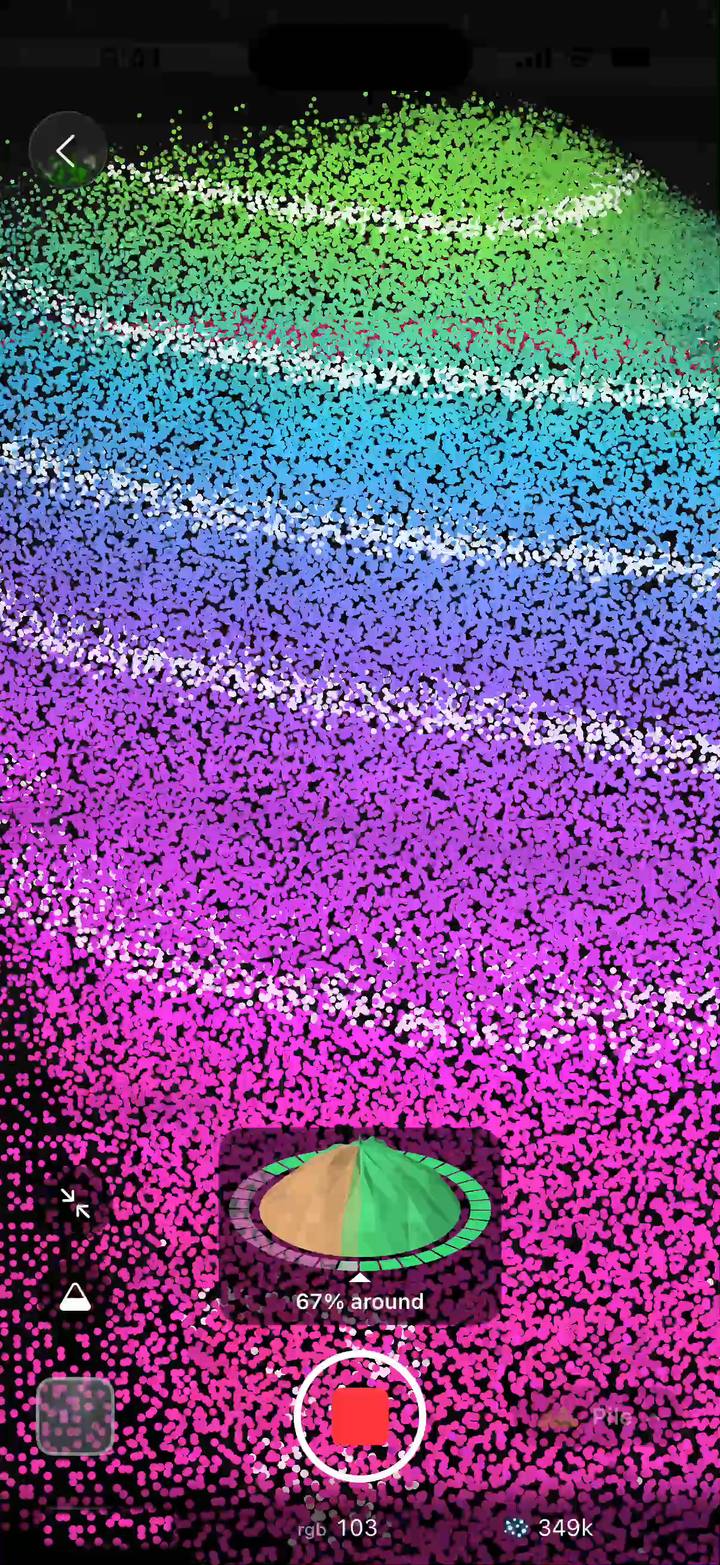
The tape method takes two people and fifteen minutes and still assumes a shape. A phone scan measures the shape that is actually there. With Stockpile Scan, you start a scan and walk all the way around the pile keeping the whole thing in view, with slow, steady steps, and go a little past where you started so the loop closes. The guide’s ring turns green as each side is covered. The phone aligns the photos and builds a 3D surface, with nothing uploaded, then shows the volume in cubic yards, cubic meters or cubic feet together with a ± range worked out from that scan.
Drag the border if it caught part of the neighbouring pile, pick the material or type your own density for a weight estimate, and save a PDF report if you need to show someone. Good light and a full loop matter most; LiDAR narrows the ± range when the phone has it, but any iPhone running iOS 18 can scan.
Tape versus scan on the same pile
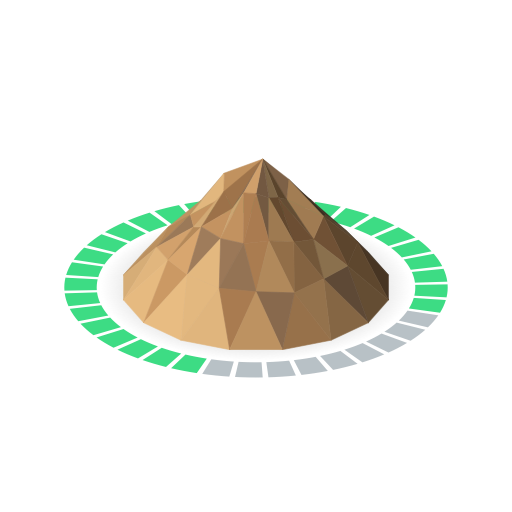
The gravel pile in the pictures on this site has a footprint of 175 ft² and stands 4.08 ft high. Treat it as a cone and you get a diameter of about 14.9 ft and a volume of ⅓ × 175 × 4.08 ≈ 238 ft³, or 8.8 yd³. The scan measured about 12.1 yd³ ±2.0. The difference is real: the pile had a broad, nearly flat top, and a cone assumes a point. Three cubic yards of crushed stone is more than four tons of material.
For ordering a bit more mulch, the cone is fine. For checking a delivery, settling a bill, or valuing a yard full of piles, measure the actual surface. Our guide to checking a mulch, topsoil or gravel delivery walks through the receipt-and-measure routine, and how accurate a stockpile measurement really is explains the ± range and what moves it.
Frequently asked questions
How do I calculate the cubic yards in a pile of gravel?
Measure the pile’s base diameter in two directions and average them, measure its vertical height, then multiply 0.2618 × diameter² × height to get cubic feet and divide by 27 for cubic yards. A pile 14 feet across and 4 feet high is about 205 cubic feet, or 7.6 cubic yards. If the top is flat rather than pointed, measure the top diameter too and use the frustum formula, or scan the pile with a phone app.
How many tons is a pile of gravel?
Multiply the volume in cubic yards by the stone’s loose density, usually 1.4 to 1.7 US tons per cubic yard, with 1.35 to 1.4 a common supplier figure for three-quarter-inch crushed stone. A 7.6-cubic-yard pile is about 10 to 11 tons, or up to 13 tons if the stone is dense and wet.
How do I measure a pile of dirt or topsoil?
The same way as gravel: average base diameter, vertical height, cone formula, divide by 27. Dirt piles dumped by an excavator are often flatter and more spread out than stone, so measure the top width as well and use the frustum formula, or scan it. Convert to weight at about 1.0 to 1.3 US tons per cubic yard for dry topsoil and 1.1 to 1.5 for fill dirt.
How do I measure a pile of mulch?
Measure it like any other pile, but the number that matters is the volume, because mulch is sold by the cubic yard rather than by weight. One cubic yard covers roughly 100 square feet at three inches deep, so a 5-yard pile should cover about 500 square feet of beds. Mulch weighs only 0.2 to 0.4 US tons per cubic yard.

Measure your next pile with your iPhone
Stockpile Scan is free, with no ads, subscriptions or account. Walk around a pile and get its volume, a ± range, a weight estimate and a PDF report, all on the phone.
Any iPhone with iOS 18 or later. LiDAR optional. Learn more about the app.