
How-To Guides · For homeowners & landscapers
Did You Get the Full Load? How to Check a Mulch, Topsoil or Gravel Delivery
Bulk material is sold by a number you never see measured. Here is how to check that the pile in your driveway is the five yards you paid for, before it gets spread and the question becomes unanswerable.
In short
- A cubic yard is 27 cubic feet. Five yards dumped in a clean cone is roughly 11½ ft across and 4 ft high; three yards is about 9½ ft by 3⅓ ft.
- Measure before you spread: the truck bed (length × width × depth ÷ 27) or the pile itself with a tape or a phone scan.
- Material settles a few percent in transit. A pile that is 20–30% short is not settling.
- Get a receipt that names the business and states the quantity and unit. It is your evidence if you have to call the supplier or your state’s weights-and-measures office.
Before the truck arrives
Order in writing, with the quantity and the unit: five cubic yards, or seven tons, not “a load”. If the yard sells by the scoop, ask for the loader bucket’s rated volume in writing. Scoops are not a standard unit; one yard’s scoop is a full cubic yard and another’s is half of one, and both will be called “a scoop” on the invoice. Ask which truck the order is coming on and how much it holds, so you know whether a 5-yard order arriving in a 12-yard truck is supposed to look half empty. Our guide to how many cubic yards fit in a dump truck has the typical capacities.
It also pays to know the coverage you expect. A cubic yard of mulch covers roughly 100–108 square feet at three inches deep, according to Hunker’s mulch coverage figures, so five yards should cover about 500 square feet of beds. If you run out at 350, you have a second data point.
Checking the load while it is still on the truck
If you are home when the truck arrives, look in the bed before the driver dumps. Measure the inside length and width of the bed and the depth of material in it, multiply the three in feet and divide by 27. A bed 14 ft long and 7 ft wide with material 3 ft deep holds 294 ft³, or about 10.9 yd³, level with that depth. If the load is heaped above the sides, estimate the heap as a ridge: half its width times its height times its length, and add it.
This is the check that consumer-protection offices recommend. Bucks County, Pennsylvania’s guidance on mulch and soil deliveries tells buyers to confirm, while the load is still in the truck or once it is dumped, that the amount delivered matches the amount ordered, and to use decimal feet (3½ feet is 3.50) so the arithmetic comes out right.
Checking the pile after it is dumped
Most of the time you will come home to a pile. A dumped load is close to a cone, so measure straight across its base in two directions, average them, measure the vertical height, and compute 0.2618 × diameter² × height for cubic feet; divide by 27 for yards. Our step-by-step on measuring a pile of gravel, dirt, sand or mulch covers the details, including the long ridge a truck leaves when it pulls forward while dumping.
The table gives you a quick picture of what each order size should look like as a clean cone at a 35° angle of repose. Dumped mulch and wet topsoil slump wider and lower than this, so use the formula with your own measurements rather than matching the picture by eye.
| Ordered | Cubic feet | Cone diameter | Cone height |
|---|---|---|---|
| 1 yd³ | 27 | 6.7 ft | 2.3 ft |
| 2 yd³ | 54 | 8.4 ft | 2.9 ft |
| 3 yd³ | 81 | 9.6 ft | 3.4 ft |
| 5 yd³ | 135 | 11.4 ft | 4.0 ft |
| 10 yd³ | 270 | 14.3 ft | 5.0 ft |
| 15 yd³ | 405 | 16.4 ft | 5.8 ft |
A perfect cone at a 35° angle of repose, from V = 0.2618 × D² × h with h = 0.35 × D. Real piles spread wider and sit lower.
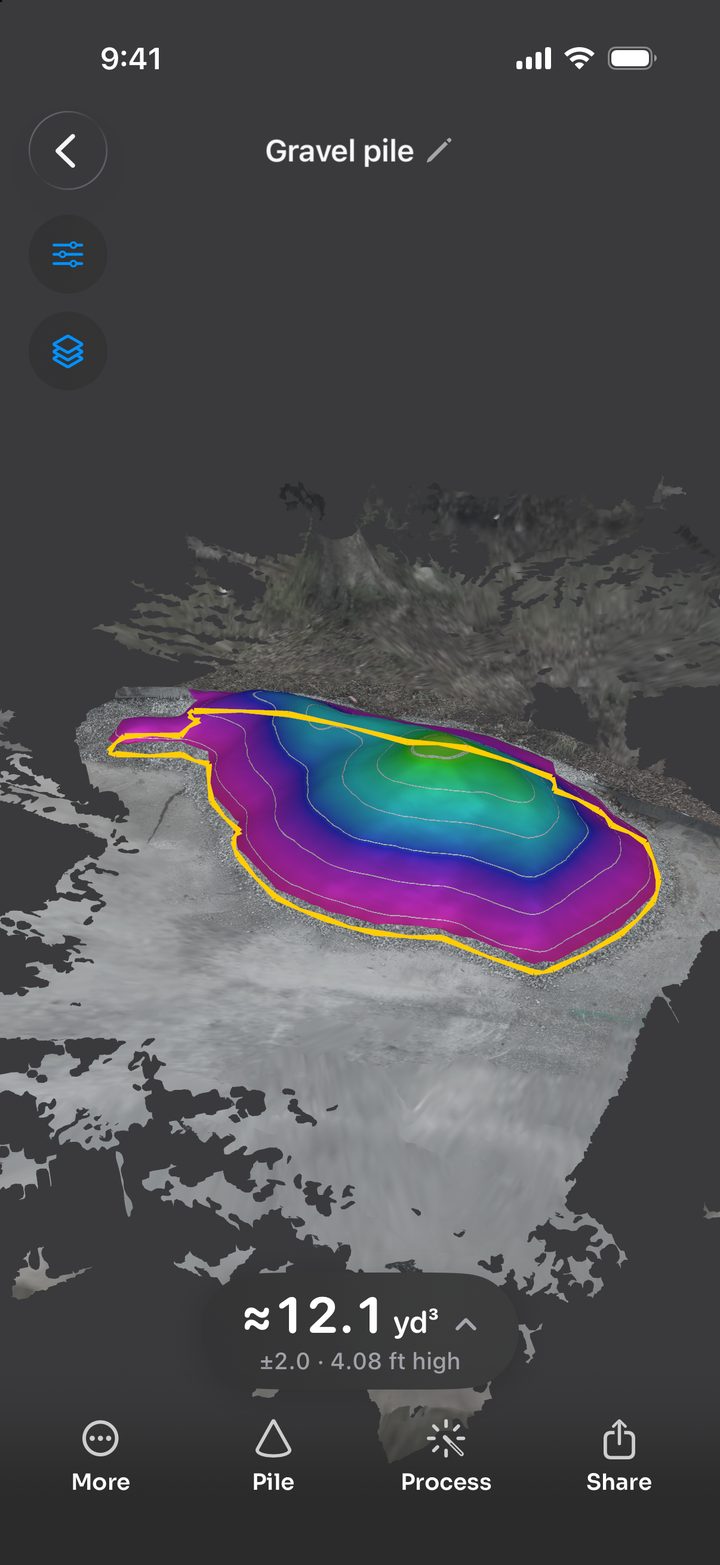
The faster check is to scan the pile. Open Stockpile Scan, walk once around the pile with all of it in view, and read the volume in cubic yards with a ± range worked out from that scan, before anyone has touched it. Pick the material and it estimates the weight too, which is useful when the ticket is in tons and the order was in yards. The PDF report is dated and includes photos, which is exactly what you want in hand if the conversation with the supplier gets difficult.
How much settling is normal
Loose material compacts on the drive over. Vibration shakes the air out of mulch and soil in particular, and the same material measures a little less in the bed on arrival than it did under the loader. The Bucks County guidance notes this directly: expect the load to have settled some in transit. A few percent is ordinary. Ten percent is on the edge. A 5-yard order that measures 3½ yards is not settling, and the supplier knows it.
Moisture works the other way around. Wet mulch weighs far more than dry mulch but takes up the same space, which is one reason mulch and soil are sold by volume; see buying by the ton or by the yard. A volume check is robust to rain. A weight check is not.
What a cubic yard looks like
Twenty-seven cubic feet is a cube three feet on a side, roughly the size of a washing machine and a half. On the ground it is a cone about 6½ feet across and a little over 2 feet high. It fills a full-size pickup bed to about level with the sides, give or take the wheel wells, and it is roughly nine to fourteen wheelbarrow loads depending on the barrow and how high you heap it. Spread three inches deep it covers a patch about 10 by 10 feet.
The receipt
Consumer-protection guidance is consistent on this. Bucks County’s firewood and mulch sales requirements say the receipt should carry the name and address of the business and state the quantity delivered, in the unit it was sold in. Many states regulate bulk sales of mulch and soil through their weights-and-measures laws for the same reason they regulate firewood: the buyer cannot verify the quantity at the point of sale. Do not accept a receipt that just says “mulch” and a price.
If the load is short
- Do not spread it yet. Once it is in the beds, nobody can measure it.
- Measure or scan it, and photograph it with the tape in frame. Note the date and time.
- Call the supplier the same day with your numbers. Most reputable yards will send a top-up without an argument, especially when you can show a measured volume rather than a feeling.
- If they refuse, your state’s weights-and-measures office (often part of the Department of Agriculture) handles bulk commodity sales, and a county consumer-protection office can help you file.
Suppliers have their own tools on the way out of the yard. Some run load-volume scanners over every truck; Loadscan’s case study with an Illinois mulch producer describes exactly that. A yard that measures its own loads can show you the scan or scale ticket for yours, and asking for it is a reasonable request. For everything else that goes into a measured volume, start with how to measure a stockpile.
Frequently asked questions
How do I know if I got 5 yards of mulch?
Measure the pile before you spread it. Five cubic yards is 135 cubic feet, which as a clean cone is about 11 to 12 feet across and 4 feet high; dumped mulch sits wider and lower, so measure the base and height and use 0.2618 times the diameter squared times the height, divided by 27. Spread three inches deep, five yards should cover about 500 square feet. A phone scan gives you the volume directly.
How much does mulch settle during delivery?
A few percent. Vibration in the truck shakes air out of loose mulch and soil, so the load measures slightly less on arrival than it did under the loader. Ten percent is on the edge of normal. A load that is 20 to 30 percent short is not settling.
Is a scoop of mulch a cubic yard?
Only if the yard’s loader bucket holds a cubic yard, and many do not. Scoops are not a standard unit: some are a full yard, some half, some two. Ask for the bucket’s rated volume in writing before you order, and have the receipt state the quantity in cubic yards.
What can I do if my gravel delivery was short?
Measure or scan the pile before it is spread, photograph it with a tape in frame, and call the supplier the same day with the measured volume. Most will top up the order. If they will not, your state’s weights-and-measures office, usually in the Department of Agriculture, regulates bulk commodity sales and can take a complaint.

Measure your next pile with your iPhone
Stockpile Scan is free, with no ads, subscriptions or account. Walk around a pile and get its volume, a ± range, a weight estimate and a PDF report, all on the phone.
Any iPhone with iOS 18 or later. LiDAR optional. Learn more about the app.
Related articles
Sources and further reading
- Bucks County, PA: consumer guidance on checking mulch and soil deliveries
- Bucks County, PA: firewood and mulch sales requirements (receipt contents)
- Hunker: how much will a cubic yard of mulch cover?
- Loadscan: truck-load scanning at an Illinois mulch producer
- Inch Calculator: cubic yards to tons calculator