Concepts · For everyone
How Much Does a Cubic Yard Weigh? Density Table for Gravel, Sand, Dirt, Mulch, Compost and Wood Chips
A cubic yard of mulch weighs about as much as a motorcycle. A cubic yard of crushed stone weighs about as much as a car. Here is the full table, why the numbers move, and how to turn a pile’s volume into tons.
In short
- Crushed stone and gravel: 2,800–3,400 lb (1.4–1.7 US tons) per loose cubic yard. Sand: 2,600–3,000 lb dry.
- Topsoil: 2,000–2,600 lb dry. Mulch: 400–800 lb. Wood chips: 500–800 lb. Compost: 1,000–1,600 lb.
- Wet material weighs 10–20% more than dry. Grading, compaction and organics move the figure too, so a supplier’s number beats any table.
- Tons = cubic yards × tons per yard. A 12.1-yard pile is about 16–17 tons as crushed stone and about 4 tons as shredded hardwood mulch.
How much a cubic yard weighs, by material
The table gives the weight of one loose cubic yard as it comes off a truck or sits in a pile, in pounds, US tons (2,000 lb) and kilograms per cubic meter. The ranges are real: the same product from two suppliers, or the same pile on a dry day and a wet one, will land at different points inside them. The figures come from supplier calculators and engineering references such as Inch Calculator, Aggregate Markets and the Engineering ToolBox.
| Material | lb per cubic yard | US tons per cubic yard | kg per cubic meter |
|---|---|---|---|
| Crushed stone, ¾ in (#57) | 2,800–3,400 | 1.4–1.7 | 1,660–2,020 |
| Pea gravel, river rock | 2,700–2,800 | 1.35–1.4 | 1,600–1,660 |
| Sand, dry | 2,600–3,000 | 1.3–1.5 | 1,540–1,780 |
| Sand, wet | 3,000–3,400 | 1.5–1.7 | 1,780–2,020 |
| Topsoil, screened, dry | 2,000–2,600 | 1.0–1.3 | 1,190–1,540 |
| Fill dirt | 2,200–3,000 | 1.1–1.5 | 1,300–1,780 |
| Clay, dry | ~1,700 | ~0.85 | ~1,010 |
| Clay, wet | ~2,970 | ~1.5 | ~1,760 |
| Garden soil blends | 2,200–2,700 | 1.1–1.35 | 1,300–1,600 |
| Mulch, shredded bark or hardwood | 400–800 | 0.2–0.4 | 240–475 |
| Wood chips | 500–800 | 0.25–0.4 | 300–475 |
| Compost | 1,000–1,600 | 0.5–0.8 | 590–950 |
| Concrete, solid | ~4,050 | ~2.0 | ~2,400 |
| Concrete, broken | ~2,025 | ~1.0 | ~1,200 |
| Asphalt millings | 2,400–2,800 | 1.2–1.4 | 1,420–1,660 |
| Road salt (rock salt) | 1,900–2,200 | 0.95–1.1 | 1,130–1,300 |
Loose, as delivered. Ranges are typical, not limits; confirm the density of a specific product with its supplier.
Why the same material weighs different amounts
Moisture. Water fills the air spaces between particles and adds weight without adding volume. Wet sand weighs 10–20% more than dry sand, and a pile that looks dry on the surface can be holding water a foot down. Topsoil and mulch swing even more because they soak water up.
Grading. A well-graded crushed stone, with fines filling the gaps between larger pieces, is denser than a clean, single-size stone where every gap is air. That is why ¾-inch clean stone and crusher run from the same quarry weigh differently per yard.
Compaction. A yard that has been driven on or has sat under its own weight for a season holds more material than a freshly dumped yard. The bank, loose and compacted yards guide covers how much.
Rock type and organics. Limestone runs lighter than trap rock or river rock; Aggregate Markets lists limestone at about 98 lb/ft³ and river rock at about 103. Topsoil with a lot of organic matter is lighter than fill dirt that is mostly mineral. The Designing Buildings reference on weight and volume makes the same point: source, grading, shape, moisture, handling and compaction all move the number.
How to convert cubic yards to tons
Multiply the volume in cubic yards by the density in tons per cubic yard:
Tons = cubic yards × tons per cubic yard
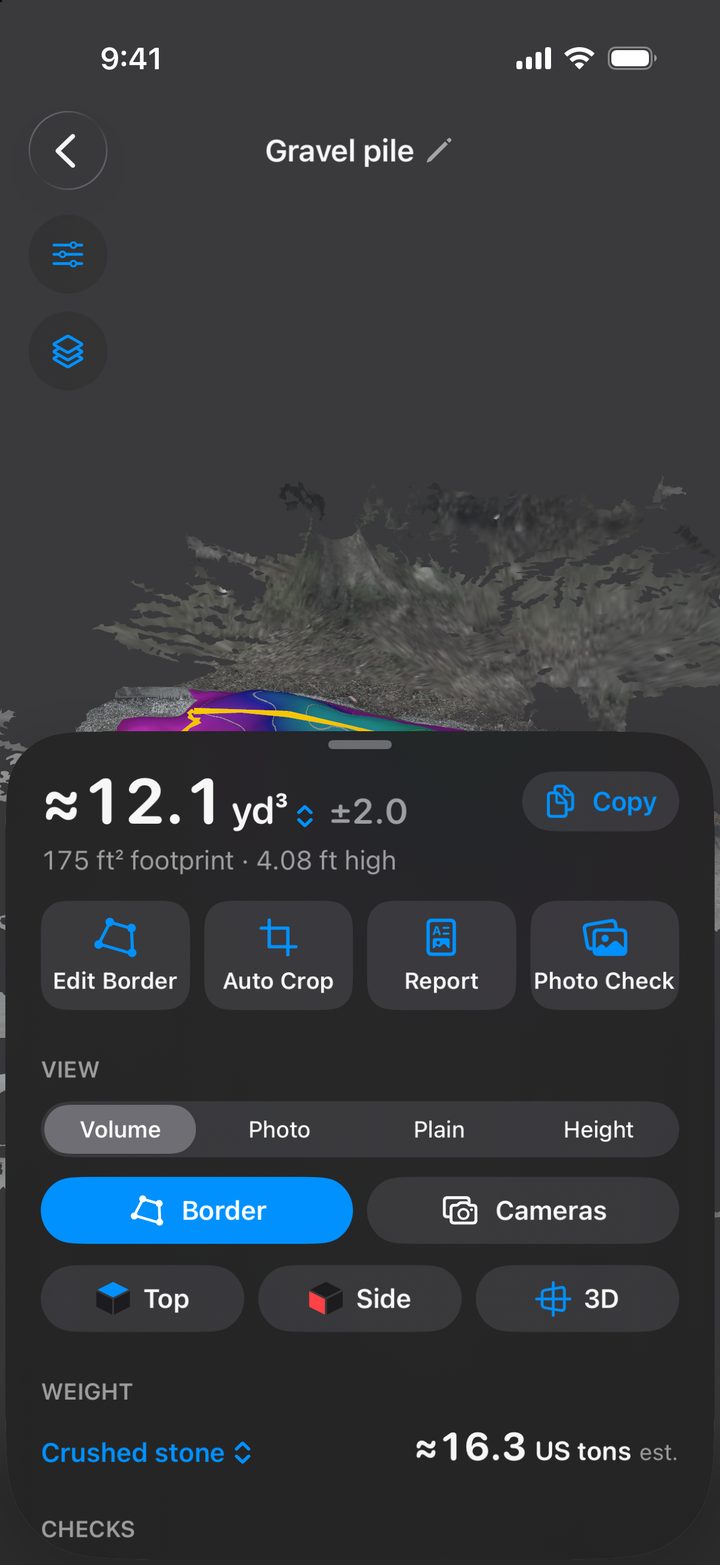
A 12.1-cubic-yard pile, the example scan on this site, is about 16–17 US tons as ¾-inch crushed stone at 1.35–1.4 tons per yard. The same volume of shredded hardwood mulch at 0.34 tons per yard is about 4 tons. The reverse conversion divides: 10 tons of gravel at 1.4 tons per yard is about 7 cubic yards, which is roughly what a short tandem load looks like on the ground. For metric, 1 US ton is 0.907 metric tons, and the kg/m³ column converts a cubic-meter volume directly.
What a pickup or trailer can really carry
Volume rarely limits a small load; weight does. A half-ton pickup bed holds 2–3 cubic yards of mulch by volume but only about a half-ton of payload, which is around half a cubic yard of gravel or a full yard of light mulch. A 10–12 foot tandem dump trailer holds 3.9–4.6 cubic yards, but 4 yards of crushed stone weighs close to 6 tons, which exceeds many trailers’ ratings. Our guide to how many cubic yards fit in a dump truck runs through the sizes.
How suppliers quote weight and volume
Stone, sand and gravel are usually sold by the ton over a scale, because weight does not change when the load settles in transit. Mulch, topsoil and compost are usually sold by the cubic yard, because their weight changes so much with moisture that a ton of wet mulch and a ton of dry mulch are very different amounts of material. When you buy stone by the ton you are also buying whatever water it holds that day, which is why buying gravel by the ton or by the yard is a real question. Ask the supplier for the density they use to convert; many quote 1.35–1.4 tons per yard for crushed stone and will put it on the ticket.
Applying a density to a measured pile
Any method that gives you a volume, from the cone formula to a drone survey, needs this same multiplication to become tons. In Stockpile Scan you pick the material from a list or type your own density, and the pile sheet shows the weight estimate in US or metric tons next to the volume. Because the volume carries a ± range worked out from the scan, the weight inherits that range plus whatever uncertainty is in the density you chose. If a supplier has given you a figure for their product, use it instead of the list value: it will be closer than any generic table, this one included. The overview of how to measure a stockpile covers the volume side.
Frequently asked questions
How many tons are in a cubic yard of gravel?
About 1.4 to 1.7 US tons for crushed stone and gravel, or 2,800 to 3,400 pounds. Many suppliers quote 1.35 to 1.4 tons per cubic yard for ¾-inch crushed stone. Wet or well-graded material sits at the top of the range.
How much does a yard of topsoil weigh?
Screened topsoil weighs about 2,000 to 2,600 pounds per cubic yard when dry, or 1.0 to 1.3 US tons. Wet topsoil can reach 3,000 pounds, and heavy fill dirt or clay more still.
How much does a yard of mulch weigh?
Shredded mulch weighs about 400 to 800 pounds per cubic yard, with shredded hardwood near 675 pounds. Fresh wood chips run 500 to 800 pounds. Wet mulch can weigh considerably more, which is why mulch is sold by the yard rather than the ton.
How much does a yard of concrete weigh?
Solid concrete weighs about 4,050 pounds per cubic yard, roughly 2 US tons. Broken concrete with air between the pieces weighs about 2,025 pounds per cubic yard, which is why a 10-yard dumpster of rubble reaches its 10-ton weight limit.

Measure your next pile with your iPhone
Stockpile Scan is free, with no ads, subscriptions or account. Walk around a pile and get its volume, a ± range and a weight estimate for the material you choose, all on the phone.
Any iPhone with iOS 18 or later. LiDAR optional. Learn more about the app.
Related articles
Sources and further reading
- Inch Calculator: Cubic yards to tons, with material densities
- Aggregate Markets: Material calculators and densities
- Designing Buildings: Converting between weight and volume for bulk construction materials
- Engineering ToolBox: Densities of dirt, mud, sand and clay
- Dumpsters.com: How much does concrete weigh?