Concepts · For everyone
Stockpile Volume Formula: Cones, Ridges and Angle of Repose, With Worked Examples
A pile is roughly a cone, a flat-topped cone or a ridge. Here are the formulas for each, worked through in feet and meters, with the angles of repose that let you estimate a height you can’t reach.
In short
- A conical pile is ⅓ × π × r² × h. In feet, 0.2618 × D² × h gives cubic feet; divide by 27 for cubic yards.
- A loader-built ridge is a triangular prism plus a cone: ½ × W × H × L, plus 0.2618 × W² × H for the two half-cone ends.
- When you can’t measure the height, use the angle of repose: h = r × tan θ. Crushed stone rests near 45°, dry sand near 34°.
- Formulas assume a tidy shape. Real piles with flat tops, loader cuts and uneven bases put them off by 15–30%, which is where scanning takes over.
The three shapes a stockpile takes
Loose material takes a few shapes, each with a formula. Material dropped from a conveyor, a chute or a single truck makes a cone. A pile a loader has driven on, or one that has been topped off and then sloughed, becomes a flat-topped cone, or frustum. A pile built along a line by a loader or stacker is a ridge: a triangular prism with a half-cone on each end. Anything messier can be split into these pieces and added up.
The stockpile volume formula for a cone
A cone’s volume is one third of its base area times its height:
V = ⅓ × π × r² × h, where r is the radius of the base and h is the height to the peak.
Because you usually measure the diameter D rather than the radius, a shortcut in feet saves a step: V (ft³) ≈ 0.2618 × D² × h. The constant is π ÷ 12, and it works in meters too. Bulk-materials engineers have used this form for decades, and the Engineering ToolBox stockpile calculator does the same arithmetic.
In feet: a pile 30 feet across the base and 9 feet high is 0.2618 × 900 × 9 ≈ 2,120 ft³, or about 78.5 cubic yards after dividing by 27. In meters: a pile 12 meters across and 4 meters high is ⅓ × π × 6² × 4 ≈ 150.8 m³, about 197 cubic yards.
Flat-topped piles: the frustum formula
Once a loader has flattened the top, the cone formula undershoots badly. Use the frustum formula, with R the base radius, r the radius of the flat top and h the height to the top surface:
V = ⅓ × π × h × (R² + R × r + r²)
Example: a pile 30 feet across at the base, 10 feet across on top and 8 feet high. R = 15, r = 5, h = 8, so V = ⅓ × π × 8 × (225 + 75 + 25) ≈ 2,723 ft³, about 101 cubic yards. Treating that same pile as a cone 30 feet across and 8 feet high gives only 1,885 ft³, or 70 cubic yards, which is 31% low. The flat top is where the missing material lives.
Ridge and windrow piles
A ridge is a triangular prism with conical ends. Measure its base width W, its crest height H, and the length L of the straight crest before the ends round off. The two half-cone ends together make one cone of diameter W and height H:
V = ½ × W × H × L + 0.2618 × W² × H
Example: a loader-built ridge 20 feet wide, 8 feet high, with a 60-foot straight crest. The prism is ½ × 20 × 8 × 60 = 4,800 ft³ and the ends add 0.2618 × 400 × 8 ≈ 838 ft³, for 5,638 ft³ or about 209 cubic yards. Rounder compost and manure windrows use a different field method, covered in measuring compost, manure and silage piles.
| Pile shape | Formula (feet in, ft³ out) | Example | Result |
|---|---|---|---|
| Cone | 0.2618 × D² × h | D = 30 ft, h = 9 ft | 2,120 ft³ ≈ 78.5 yd³ |
| Flat-topped cone (frustum) | ⅓ × π × h × (R² + R × r + r²) | R = 15 ft, r = 5 ft, h = 8 ft | 2,723 ft³ ≈ 101 yd³ |
| Ridge with conical ends | ½ × W × H × L + 0.2618 × W² × H | W = 20 ft, H = 8 ft, L = 60 ft | 5,638 ft³ ≈ 209 yd³ |
| Irregular pile | Split into the shapes above and add them | — | — |
Divide cubic feet by 27 for cubic yards. In meters the same formulas give cubic meters directly.
Angle of repose: finding a height you can’t measure
Loose material settles at a characteristic slope called the angle of repose. If a pile is a clean cone and you know its material, you can estimate the height from the base alone: h = r × tan θ. Dry sand rests near 34°, so a 30-foot sand cone stands about 15 × tan 34° ≈ 10 feet tall. Crushed stone rests closer to 45°, which makes the same footprint 15 feet tall and the volume half again larger.
That sensitivity is the point: on a 30-foot base, each 5° of slope moves the volume by roughly 15–20%, so an assumed angle is a weak substitute for a measured height. The Engineering ToolBox table of repose angles is a good starting place, and 911 Metallurgist’s note on stockpile capacity adds that a pile drawn down from underneath stands steeper still. A face steeper than the material’s natural angle has been cut by a loader, and the cone formula no longer fits.
| Material | Angle of repose | Height of a 30 ft cone |
|---|---|---|
| Natural gravel with sand | 25–30° | 7–8.7 ft |
| Dry sand | ~34° | ~10 ft |
| Soil, loose | 30–45° | 8.7–15 ft |
| Crushed stone | ~45° | ~15 ft |
| Wet sand | ~45° | ~15 ft |
| Bark and wood chips | ~45° | ~15 ft |
Approximate resting angles. A pile at rest is a few degrees steeper than material in motion, and moisture and particle shape move the figures.
From cubic feet to cubic yards to tons
Divide cubic feet by 27 for cubic yards, or multiply cubic meters by 1.308. Weight needs one more number, the material’s loose density. The 78.5-cubic-yard cone above weighs about 110 US tons as ¾-inch crushed stone at 1.4 tons per yard, and about 27 tons as shredded hardwood mulch at 0.34. Our density table for gravel, sand, dirt, mulch, compost and wood chips has the ranges; a supplier’s figure beats any table.
Where the formulas break
Every formula here assumes a tidy shape on a flat base, and real piles rarely cooperate. Loader cuts leave near-vertical faces no cone has. Flat tops hide material, as the frustum example shows. A base that slopes a few percent puts extra volume under the downhill side that a level-base formula never sees. Scalloped faces, merged piles and a pile pushed against a wall all defeat the geometry. Add these up and 15–30% error is normal: fine for ordering, not for an inventory or an invoice.
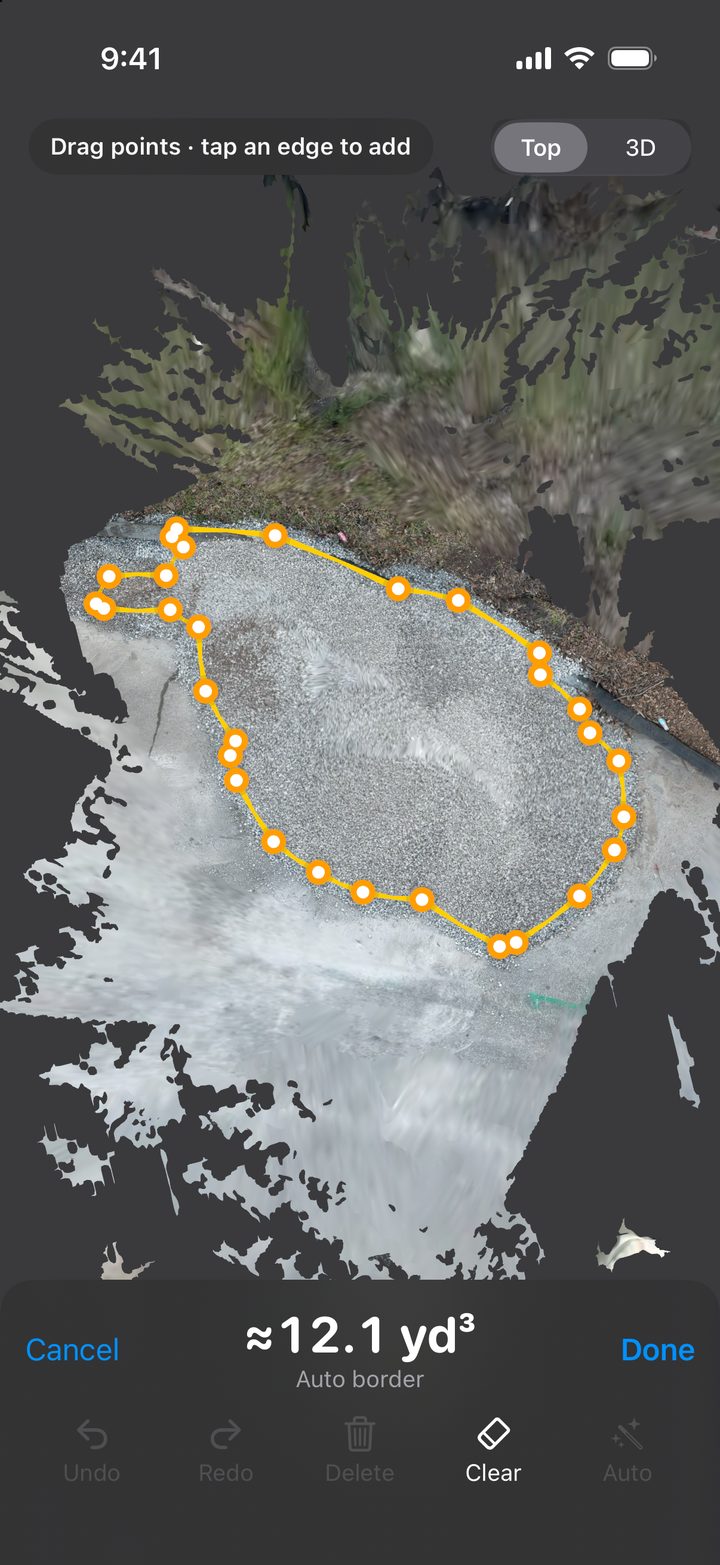
When the number matters, measure the surface instead of assuming it: a laser survey, a drone or a phone scan records the pile as it is. Stockpile Scan does this from a walk around the pile, building the actual surface, letting you drag the border to the footprint you mean, and reporting the volume with a ± range worked out from that scan. How to measure a stockpile compares the options, how accurate a stockpile measurement is explains what moves the number once shape is no longer the problem, and the guide to measuring a pile of gravel walks through tape and scan on one driveway pile.
Frequently asked questions
What is the formula for the volume of a stockpile?
For a conical pile, volume = ⅓ × π × radius² × height. In feet, 0.2618 × diameter² × height gives cubic feet; divide by 27 for cubic yards. A flat-topped pile uses the frustum formula ⅓ × π × h × (R² + R × r + r²), and a ridge uses ½ × width × height × length plus one cone for the two ends.
How do I calculate the cubic yards in a pile?
Measure the pile in feet, apply the formula for its shape to get cubic feet, then divide by 27. A cone 30 feet across and 9 feet high is 0.2618 × 900 × 9 ≈ 2,120 cubic feet, or about 78.5 cubic yards. Multiply by the material’s density in tons per cubic yard if you need tons.
How do I measure the height of a pile without climbing it?
Hold a pole or a level line against the pile from the side, use a laser rangefinder with an inclinometer, or estimate from the angle of repose with h = r × tan θ when the pile is a clean cone of known material. A phone or drone scan measures the height directly as part of the 3D surface.
How accurate is the cone formula for a stockpile?
On a fresh cone dropped from a conveyor it can be within about 5 percent. On a pile a loader has worked, with a flat top, cut faces and an uneven base, 15 to 30 percent error is typical. Scanning the surface removes the shape assumption and is the next step when the volume matters.

Measure your next pile with your iPhone
Stockpile Scan is free, with no ads, subscriptions or account. Skip the cone assumption: walk around the pile and get its measured volume, a ± range, a weight estimate and a PDF report.
Any iPhone with iOS 18 or later. LiDAR optional. Learn more about the app.