
How-To Guides · For yards, quarries & crews
Monthly Stockpile Counts for Small Yards: A Phone Workflow for Landscape Supply, Mulch and Aggregate Dealers
Most small bulk-material yards buy by the ton, sell by the yard or the scoop, and find out once a year how much went missing. A monthly walk of every pile with a phone fixes that in about an hour.
In short
- Landscape supply inventory leaks through unit conversion, moisture, compaction, unticketed loads and loader scoops that drift in size. None of it shows up until something is measured.
- Monthly counts beat quarterly ones: a $6–7 per ton gap on 10,000 tons is a $60–70k problem, and a quarter is long enough for the cause to disappear.
- The workflow is simple: same day each month, one person, every pile walked, consistent names, the same base assumption, a density per product and a saved report per pile.
- Investigate any variance over about 10%. Most trace back to scoop size, moisture, rehandling or a pile that was split or merged.
Where a small yard loses material
A bulk yard’s stock is a dozen piles on a pad; its books are numbers that were right on the day of the last delivery. Between the two sit several leaks. Mulch, soil and stone are usually bought by weight and sold by volume or by the loader scoop, and the conversion between them moves with moisture, density and compaction; Snapshot Design’s review of landscape supply operations singles this out as a small, cumulative margin loss that nobody sees. Rain adds weight to what you buy and runoff carries fines out of what you sell. Loaders compact the pad and bury the toe. Crews take a bucket for the shop drive without a ticket. A “scoop” that was a yard in April is a yard and a quarter in July when the bucket is heaped higher.
Each leak is small. Together they are the gap between the margin on the price list and the margin in the bank, and a yard that counts once a year cannot tell which one is responsible. A monthly bulk material inventory count turns that into a dozen small, explainable variances instead of one large unexplainable one.
Why monthly, not quarterly
Propeller, which surveys quarry stockpiles by drone, argues in its guide to how often to audit aggregate inventory that quarterly is too infrequent to protect the number. Its example is a quarry’s, but the arithmetic scales: a $6 to $7 per ton gap across 10,000 tons is a $60,000 to $70,000 problem, and a quarter is long enough for the cause to have changed, left or been paved over. A yard turning 300 to 500 tons a month of mixed product has the same exposure in proportion. Monthly is also the frequency at which the cause is still visible: the wet week, the new loader operator, the pile that was pushed into its neighbor.
Small yards skip monthly counts because of cost. A survey crew for twelve piles is not worth it, and tape-and-cone estimates are rough enough to hide a 15% loss. A phone scan changes the arithmetic: a few minutes per pile, processing on the phone, a measured volume rather than a guess. The guide to stockpile measurement methods compares the options; for a dozen piles under 200 cubic yards, the phone is the one that gets done every month.
The monthly workflow
- Fix the day. First Monday, before opening, every month. Loaders parked, piles still.
- One person, every pile. The same walker removes a variable. Skip nothing, including the half-pile of leftover 57s behind the shed.
- Name piles consistently. “Bin 4 – ¾ crushed” every month, not “gravel pile” one month and “stone” the next. Name the scan the moment it finishes.
- Walk the full loop. Keep the whole pile in view, go a little past where you started, and let the app’s coverage ring close. Where a pile sits against a bin wall, walk the open sides and note the wall in the report.
- Use the same base every month. The pad surface as it is on count day. Don’t edit the border to reach a buried toe one month and not the next.
- Assign a product and density. Pick the material, or set the density you measured for that product, so the volume converts to tons the same way every time.
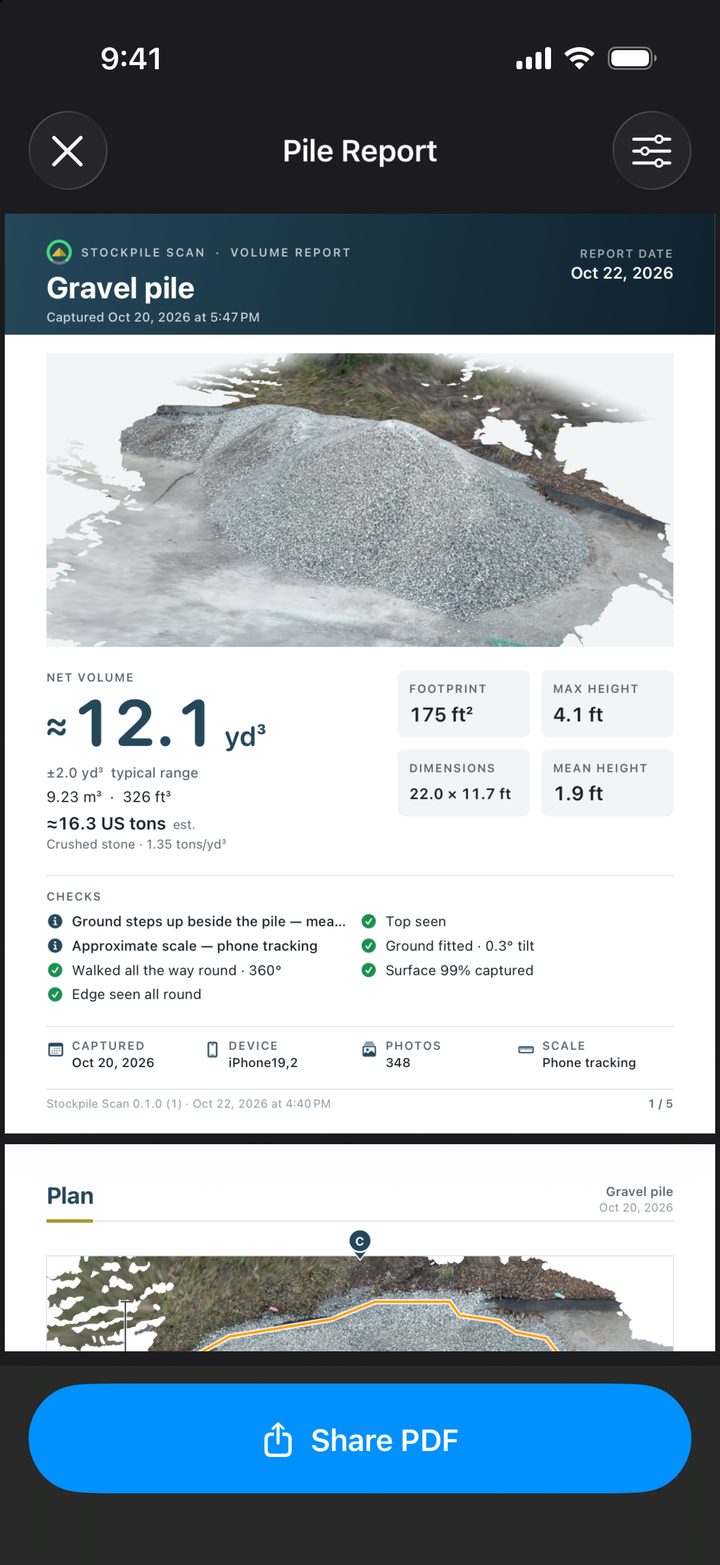
- Save a report per pile. Date, volume, ± range, footprint, weight estimate, plan view and photos. A folder of twelve PDFs is a count.
- Reconcile and flag. Compare each pile to book quantity (last count plus tickets in minus tickets out). Investigate anything over about 10%.
For a twelve-pile yard the walking takes under an hour. Stockpile Scan’s report already carries the fields above, in cubic yards or meters and US or metric tons, so the paperwork is sharing twelve files to a folder.
Calibrate your own densities
Generic density tables are the weakest link between a measured volume and the tons on your invoices. Measure yours: fill the loader bucket level, weigh it on the yard scale or a public scale, tip it out on a clean pad, scan the little pile and divide pounds by cubic yards. Repeat for each product in a wet month and a dry one, and the densities belong to your material and climate. SiteOne’s bulk material calculation guide shows how much compaction alone changes the relationship, which is why a density measured from a settled pile differs from one measured off the truck. The density table gives starting ranges; your own numbers replace them.
Reading the variances
A variance is only a problem until it has an explanation. The pattern usually points at the cause.
| Variance pattern | Likely cause | Fix |
|---|---|---|
| One product short every month, by a steady percentage | Scoop size: the bucket carries more than the yard you charge for | Measure a heaped bucket; adjust the price per scoop or the fill line |
| Mulch and soil short after a wet spell, stone fine | Moisture: you bought wet tons and sold drier yards | Use a wet-season density; buy by the yard where suppliers allow it |
| Everything short by 3–5%, every month | Compaction and runoff at the toe; book density too high | Recalibrate densities; accept a known shrink allowance |
| One pile long, its neighbor short | Rehandling or a loader pushing piles together | Mark bin edges; re-walk both and treat as one product |
| A sudden drop with no tickets | Unticketed loads or theft | Check camera and ticket log for that week; tighten gate procedure |
| Short against the supplier’s ticket on delivery day | Short load or settled load | Scan the pile before spreading; see the delivery-check guide |
The percentages are rules of thumb for yards with piles under about 200 cubic yards; larger piles show proportionally smaller swings.
The delivery-day case deserves its own habit. Scanning a fresh load before the loader touches it gives you a measured volume to set against the scale ticket, and it tells you the supplier’s delivered density for free. Our guide to checking a mulch, topsoil or gravel delivery covers what to do when the two disagree.
Reconciling tickets in and out
The count only means something against a book figure. Keep a ledger per product: opening measured volume, plus deliveries converted at the delivered density, minus sales at their true scoop volume, equals expected closing volume. Log the difference from the measured one. After three or four months the log gives your real shrink rate per product, a cost of goods you can price for; it is rarely zero and rarely the same for stone and mulch.
What the accountant and the insurer want
At year end the question changes from “how much is there” to “how do you know”. A folder of dated reports with photos, the border used, the density applied and a ± range on each volume answers it in a way a spreadsheet of guesses cannot, and it is what an insurer wants after a flood or a buyer wants if the yard is sold. For what auditors test at larger operations, see stockpile reconciliation and year-end write-offs.
Frequently asked questions
How often should a landscape supply yard count its bulk inventory?
Monthly. Quarterly counts leave three months for a leak to grow and for its cause to disappear; annual counts produce one large write-off nobody can explain. With a phone scan, a twelve-pile yard can be walked and reported in about an hour, which makes a monthly count practical.
How do I track mulch and soil inventory when I buy by the ton and sell by the yard?
Measure your own densities. Weigh a level loader bucket of each product, scan the tipped-out pile for its volume, and divide pounds by cubic yards. Repeat in wet and dry months. Convert deliveries to yards at the delivered density, sell at the true scoop volume, and compare the expected pile against a measured one each month.
What is a normal shrinkage rate for bulk landscape materials?
There is no published industry figure, and it differs by product. Yards that measure monthly commonly see a few percent a month on stone from compaction and fines loss, and more on mulch and soil in wet seasons from moisture and decomposition. The point of a monthly count is to learn your own rate per product and price for it.
Can I measure stockpiles without a drone or surveyor?
Yes. A walk-around phone scan measures the pile’s actual surface from the ground and reports its volume with a ± range, and it works in bins and under roofs where a drone cannot fly. For piles under a couple of hundred cubic yards it takes a few minutes each, which suits a monthly yard count.

Measure your next pile with your iPhone
Stockpile Scan is free, with no ads, subscriptions or account. Walk each pile, get its volume with a ± range, a weight estimate from your own density and a dated PDF report, all on the phone.
Any iPhone with iOS 18 or later. LiDAR optional. Learn more about the app.
Related articles
Sources and further reading
- Snapshot Design: landscape supply operations and the unit-of-measure problem
- Propeller: how often should you audit aggregate inventory? A quarry manager’s guide
- SiteOne: calculating bulk materials for landscape and hardscape, including compaction allowances
- Loadscan case study: measuring mulch truckloads at an Illinois supplier