
How-To Guides · For homeowners & landscapers
How to Measure a Pile of Firewood: Full Cords, Face Cords and the 180-Cubic-Foot Rule
Firewood is sold in cords but delivered in heaps. Here is how to turn a stacked row or a dumped pile into cords, why a loose pile needs about 180 cubic feet to make one, and how the law defines what you bought.
In short
- A full cord is 128 ft³ of wood stacked tightly: 4 ft high, 4 ft deep and 8 ft long. Stacked volume ÷ 128 = cords.
- Thrown loosely into a pile, a cord takes about 180 ft³ (160–200 depending on the wood). Loose volume ÷ 180 = cords.
- A face cord or rick is one row 4 ft high by 8 ft long, as deep as the pieces are long. A 16-inch face cord is about one third of a cord.
- NIST Handbook 130, adopted by most states, requires firewood to be sold by the cord or a fraction of one, not by the truckload or the pile. Get the quantity in cords on the receipt.
What a cord is, and what it isn’t
The cord is one of the few bulk units with a legal definition. NIST Handbook 130, the model law that most states adopt for weights and measures, defines it as the amount of wood contained in 128 cubic feet when the pieces are “ranked and well stowed”: stacked in parallel rows, tight, with as little air as the shape of the wood allows. The familiar picture is a stack 4 ft high, 4 ft deep and 8 ft long, but any stack whose dimensions multiply to 128 ft³ is a cord.
State pages make the consequences plain. Washington’s Department of Agriculture and Connecticut’s Department of Consumer Protection both require firewood to be sold by the cord or a fraction of a cord, and Texas does the same. A “truckload”, a “pile” or a “rick” is not a legal quantity in those states, and a seller who advertises one owes you the conversion to cords.
A face cord, also called a rick or a stove cord, is a single row 4 ft high and 8 ft long, as deep as the pieces are long. Its volume depends entirely on that length, which is why the table below exists and why “a face cord” without a piece length is not a quantity. The Wikipedia entry on the cord collects the regional names.
| Piece length | Face cord volume (4 × 8 ft row) | Fraction of a full cord |
|---|---|---|
| 12 in | 32 ft³ | ¼ |
| 16 in | 42.7 ft³ | ⅓ |
| 18 in | 48 ft³ | ⅜ |
| 24 in | 64 ft³ | ½ |
| 48 in | 128 ft³ | 1 (a full cord) |
A face cord is 4 ft × 8 ft × the piece length. Three face cords of 16-inch wood make one full cord.
Measuring a stacked pile
Stack the wood in straight rows, tight and parallel. Measure the length of the row, its height, and its depth (the piece length, or the total depth if there are several rows back to back), all in feet, and multiply. Divide by 128 for cords. A single row of 16-inch wood that is 24 ft long and 4 ft high is 24 × 4 × 1.33 = 128 ft³: exactly one cord. If the height varies along the row, measure it at several points and average.
“Well stowed” matters. A stack thrown together with pieces crossing each other holds more air than a careful one, and the law describes a tight stack. If you are the buyer, stack carefully before you measure; if you are the seller, the same care is what keeps the quantity honest.
Piece length changes how much wood fits in a cord
Short pieces nest more tightly than long ones, so a 128-cubic-foot stack of 16-inch wood contains more actual wood than a 128-cubic-foot stack of four-foot logs. The University of Wisconsin’s forestry extension fact sheet on the cord makes the point plainly: a cord measures the space a stack occupies, air included, so the solid wood inside it depends on piece length, straightness and how tightly it was stacked. A cord of four-foot wood cut down to 16-inch pieces and restacked typically settles into roughly 100–110 ft³. Sellers who cut their own wood sometimes use this to argue that a 110-cubic-foot stack of short wood “is” a cord. Under most state rules it is not; the cord is 128 ft³ as stacked and delivered to you, whatever the piece length.
Measuring a dumped (loose) pile
Most deliveries arrive as a heap, and you often have to pay before you stack. Loose, thrown firewood takes up far more room than stacked wood because the pieces cross at random. The rule of thumb most dealers quote is that about 180 cubic feet of loose wood makes one stacked cord, with a range of roughly 160–200 depending on how straight the pieces are, how uniform the lengths are, and how the heap landed.
To measure the heap, treat it as a ridge or a cone and use the same arithmetic as for any stockpile. A ridge is half its width times its height times its length, plus one cone of the ridge’s width for the two rounded ends. A heap 12 ft long, 6 ft wide and 4 ft high is ½ × 6 × 4 × 12 = 144 ft³ for the ridge plus 0.2618 × 6² × 4 ≈ 38 ft³ for the ends, about 182 ft³ in all: one loose cord, give or take. The stockpile volume formula guide has every shape, and the Engineering ToolBox stockpile calculator does the multiplication.
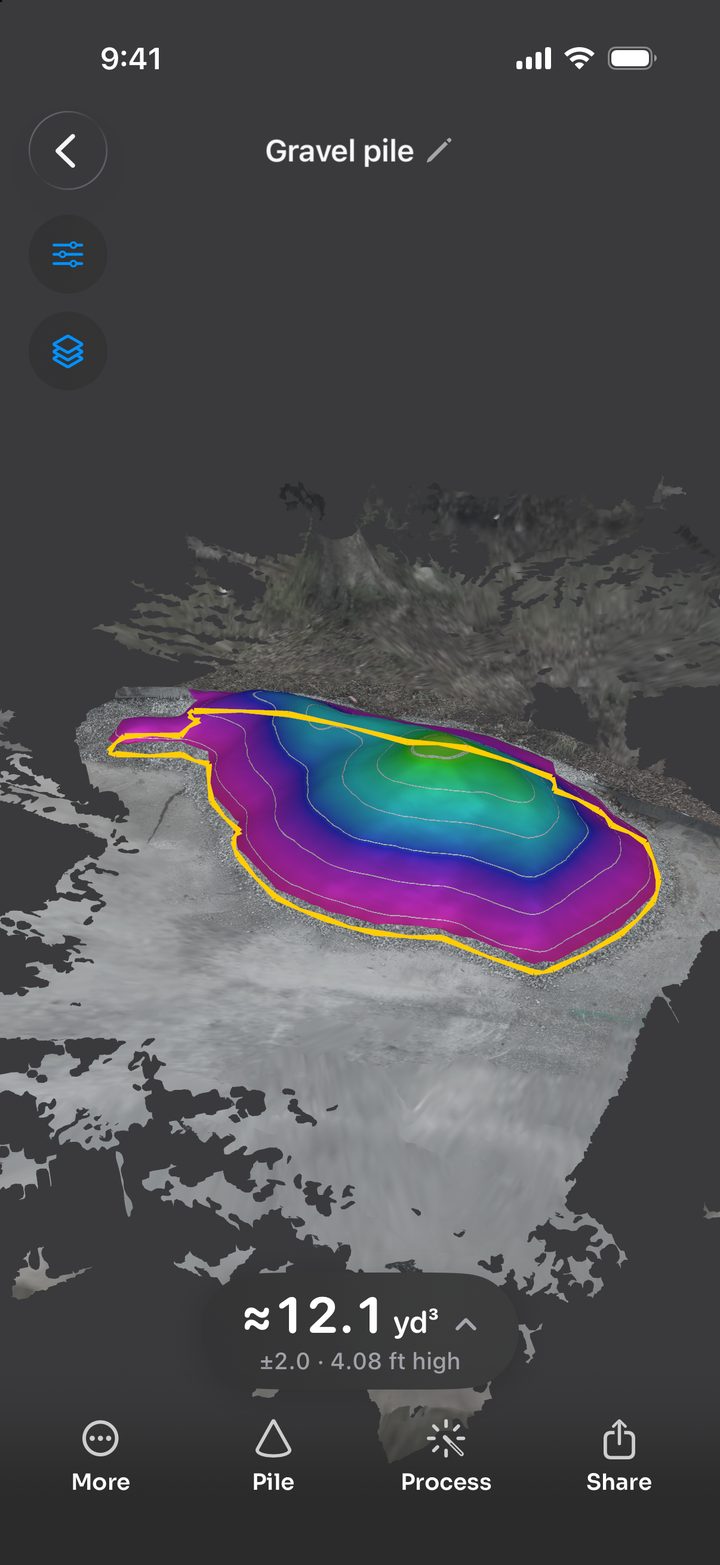
A phone scan skips the geometry. Walk once around the heap with Stockpile Scan and it reports the volume in cubic feet with a ± range worked out from that scan; divide by 180 for cords. Then stack the wood and measure the stack. The ratio between the two is your own loose-to-stacked factor for that supplier’s wood, and after one or two deliveries you will know whether their heaps run closer to 160 or 200.
What a pickup load is worth
A full-size 8-foot bed filled level with the sides holds about 65–70 ft³ of loose wood, which is roughly 0.4 of a stacked cord. Heaped to the cab roof it approaches half a cord. So “a truckload” means anywhere from a third to two thirds of a cord, which is exactly why the states refuse to recognize it as a unit. Weight limits bite too: a cord of hardwood weighs more than most half-ton pickups are rated to carry, so a dealer who says a full cord is in the back of one is mistaken about one of the two numbers.
If the pile comes up short
Stack before you pay when you can; most dealers who deliver honest cords will wait, or will accept a measured heap divided by 180 as the check. Ask for a receipt that shows the seller’s name and address, the date, the quantity in cords or fractions, and the price. Washington, Connecticut and Texas all list these receipt requirements on the pages linked above, and Bucks County’s firewood and mulch rules show that counties enforce them too.
If the stack measures short, photograph it with a tape in frame, work out the cords, and call the seller first; most will make up the difference. If they will not, the weights-and-measures office in your state’s Department of Agriculture or Consumer Protection takes firewood complaints, and a dated photo of a measured stack is the evidence they ask for. The same measure-before-you-spread discipline applies to wood chips sold by the yard and to gravel, soil and mulch; the cord is just the one bulk unit the law has already defined for you.
Frequently asked questions
How many cubic feet is a cord of wood?
A full cord is 128 cubic feet of wood stacked tightly in parallel rows, which is a stack 4 feet high, 4 feet deep and 8 feet long. Thrown loosely into a heap, the same cord takes up about 180 cubic feet, with a range of roughly 160 to 200 depending on the wood.
How many cords are in a pile of firewood?
For a stacked pile, multiply length, height and depth in feet and divide by 128. For a loose heap, estimate its volume as a ridge or cone, or scan it with a phone, and divide the cubic feet by about 180. A heap 12 feet long, 6 feet wide and 4 feet high is roughly 180 cubic feet, or about one cord once stacked.
What is a face cord of wood?
A face cord, also called a rick or stove cord, is a single row of wood 4 feet high and 8 feet long, as deep as the pieces are long. A face cord of 16-inch wood is about 42.7 cubic feet, one third of a full cord; a 24-inch face cord is half a cord. Most states do not recognize the face cord as a legal unit, so the receipt should state the fraction of a cord.
Is a truckload of firewood a cord?
No. A full-size pickup bed filled level holds about 0.4 of a stacked cord and heaped to the cab roof about half, so a truckload is anywhere from a third to two thirds of a cord. State weights-and-measures laws based on NIST Handbook 130 require firewood to be sold by the cord or a fraction of a cord, not by the truckload.

Measure your next pile with your iPhone
Stockpile Scan is free, with no ads, subscriptions or account. Walk around a pile and get its volume, a ± range, a weight estimate and a PDF report, all on the phone.
Any iPhone with iOS 18 or later. LiDAR optional. Learn more about the app.
Related articles
Sources and further reading
- NIST Handbook 130: Uniform Laws and Regulations in the Areas of Legal Metrology and Fuel Quality (defines the cord)
- Washington State Department of Agriculture: firewood information for buyers and sellers
- Connecticut Department of Consumer Protection: firewood and stove wood regulations
- Texas Department of Agriculture: weights and measures, firewood
- Bucks County, PA: firewood and mulch sales requirements
- University of Wisconsin Extension, Forestry Facts No. 44: What Is a Cord?
- Maryland Department of Agriculture: tips for buying firewood
- Wikipedia: Cord (unit)
- Engineering ToolBox: stockpile volume calculator